
Circular Steel: Enablers for a circular economy of climate-neutral steel
German Research Foundation (DFG), 1 April 2026 — 31 March 2031
Project description
The DFG Research Training Group Circular Steel is a structured doctoral research programme funded by the German Research Foundation. It brings together doctoral researchers and supervisors from different disciplines through a coordinated research and qualification programme. The Research Training Group promotes interdisciplinary collaboration, the exchange of methods and data, and the development of integrated solutions that extend beyond individual research projects.
Within this framework, Circular Steel investigates the scientific and technological foundations required for a circular and climate neutral steel industry. Its research spans primary and secondary steel production, process technology, alloy and material design, product performance, recycling, material flows, and sustainability assessment. By connecting these perspectives, the programme aims to address the entire steel cycle rather than isolated production or material related challenges.
Within the overall programme, Area I focuses on process technologies for climate neutral steel production. Topic I‑2 investigates the integrated operation of hydrogen based direct reduction and electric arc furnace steelmaking, including the effects of DRI properties and charging conditions as well as the integration of hydrogen production and waste-heat recovery.
Coupled Process Simulation of Hydrogen-Based DRI-EAF Steelmaking
Hydrogen-based direct reduction followed by electric arc furnace (EAF) steelmaking is a key route for replacing coke-based primary steel production while retaining the flexibility to use recycled scrap. Its performance depends on interfaces that cannot be resolved when hydrogen production, direct reduction and EAF steelmaking are simulated as isolated units.
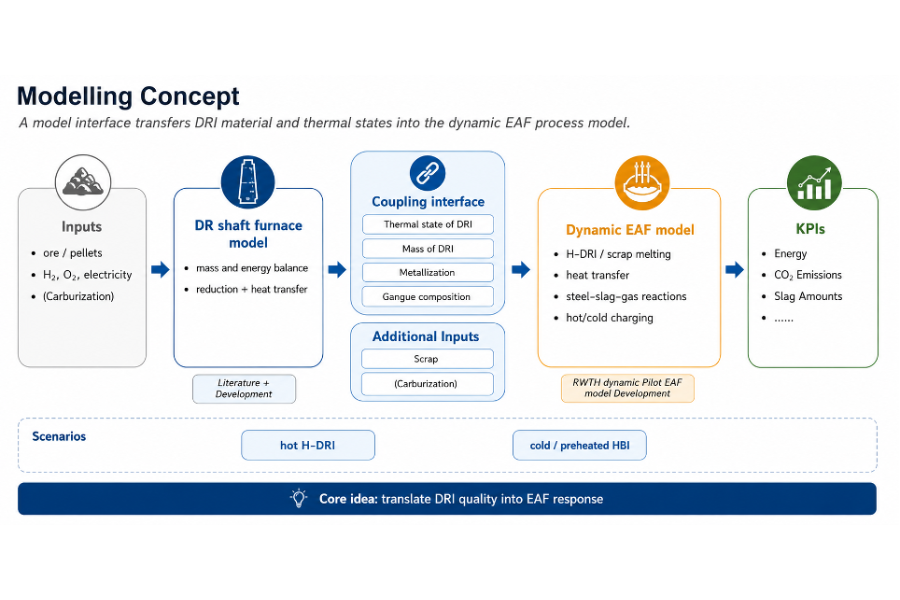
The temperature, metallization, residual oxygen and carbon, gangue composition and impurity content of direct reduced iron (DRI) determine the EAF melting energy, slag volume and composition, flux demand, foaming conditions, refractory exposure, emissions and steel quality. Charging mode is equally important: continuous hot charging of hydrogen-reduced DRI must be compared with cold or preheated hot briquetted iron (HBI) and with different scrap/DRI ratios.
Topic I‑2 develops a coupled dynamic process model for an integrated route comprising high-temperature solid oxide electrolysis (SOEC), hydrogen-based shaft-furnace direct reduction, DRI/HBI handling and EAF steelmaking. A literature-based DR model will provide the mass, composition and thermal state of the product to an enhanced RWTH dynamic EAF model. The EAF model will resolve melting and heat transfer as well as the distribution of C, O, P, S and N among steel, slag and gas. Waste heat recovery and intermediate storage of steam, hydrogen and oxygen will be integrated to quantify system-level energy and resource efficiency.
Operating scenarios will compare electricity, natural gas, hydrogen, oxygen and biogenic or other alternative carbon carriers. Hydrogen is considered for process heat, while alternative carbon carriers are assessed for carburization and slag foaming. The coupled model will identify operating windows that reduce direct fossil CO2 emissions without compromising steel, slag or process performance.
Central research question: How do DRI properties, scrap share and charging temperature propagate through EAF energy demand, slag chemistry, emissions and product quality?
Project goals
- Implement a DR shaft-furnace model, including relevant side processes, in Python using mass and energy balances, reduction kinetics and heat-transfer relations from the literature.
- Extend the available dynamic EAF process model for hydrogen-reduced DRI/HBI, flexible scrap/DRI mixtures, continuous hot charging, cold or preheated charging and hydrogen-based process heat.
- Represent steel slag gas reactions and the distribution of C, O, P, S and N, including desulfurization, dephosphorization and nitrogen pickup or removal.
- Predict slag amount and composition, flux requirements, MgO saturation and conditions relevant to slag foaming and refractory protection.
- Couple EAF waste-heat recovery with high-temperature SOEC electrolysis and buffer storage, and use scenario and sensitivity analyses to minimize energy use, direct fossil CO2 emissions and material losses while meeting product-quality constraints.
Evaluation criteria
|
Energy and integration Electricity, chemical energy, hydrogen and oxygen demand; recoverable heat; storage requirements. |
Metallurgy and quality Metal temperature and composition; P, S, N, O and C distribution; steel yield and impurity control. |
|
Slag and refractories Slag amount and composition; flux demand; MgO saturation; conditions relevant to slag foaming and refractory protection. |
Climate and resources Direct fossil CO2 emissions, alternative carbon use, by-product quality, material losses and overall resource efficiency. |
Contact

Mohamed Abouayana, M.Sc.
+49 241 80–28926

Dr.-Ing. Thomas Echterhof
+49 241 80–25958
Funding

Funded by the German Research Foundation (DFG) within Research Training Group GRK 3139 “Circular Steel — Enablers for a circular economy of climate-neutral steel”, Project ID 546471228.