
CircSmeltSteel: Low carbon and circular valorisation of secondary materials in electric furnaces for proving high quality steelmaking with excellent product properties
Horizon Europe, 1 July 2026 — 30 June 2030
Project description
The overarching objective of CircSmeltSteel is to develop and validate, within a system-level approach, new pathways for circular and low-CO2 iron and steel production. The project focuses on the use of metallurgical by-products as secondary raw materials in electric smelting aggregates, thereby contributing to improved material circularity in the steel industry.

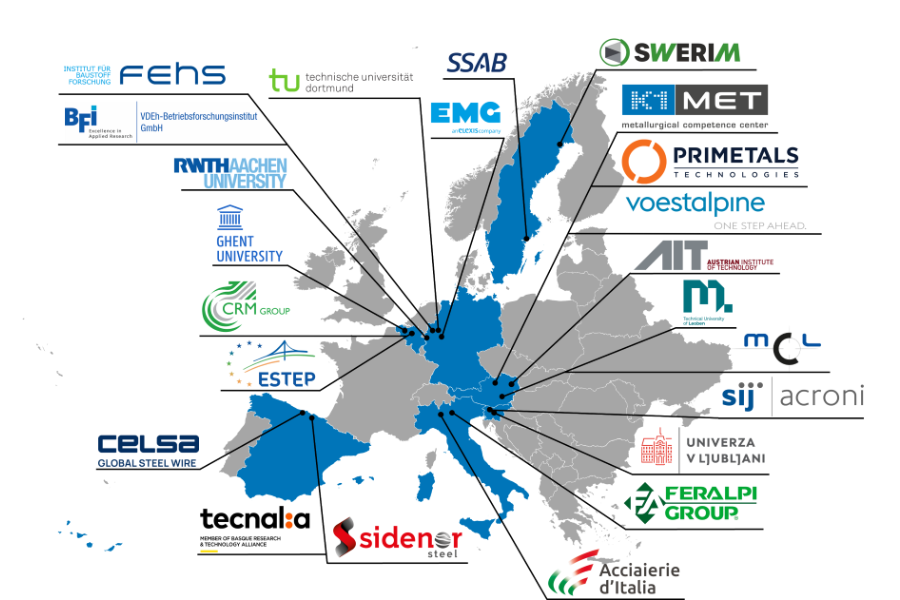
At the core of the project are two low-CO2 process routes: the Electric Smelting Furnace (ESF) for the production of green hot metal and the Electric Arc Furnace (EAF) for the production of crude steel. The project addresses the entire process chain, ranging from the preparation of primary and secondary feed materials to ESF, EAF, secondary metallurgy and casting, as well as downstream processing by hot rolling, cold rolling and annealing of the final steel products. The project duration is 48 months and the work program is structured into 10 work packages. The consortium comprises 26 partners from industry, research, plant engineering, digitalization, materials science, sustainability assessment and the social sciences.
Background and Motivation
The steel industry is undergoing a profound transformation in which conventional CO2-intensive process routes, such as sinter plants, blast furnaces and converters, are increasingly being replaced or complemented by low– technologies. At the same time, large quantities of metallurgical by-products, including dusts, sludges, slags and mill scale, are generated and are currently either recycled within integrated blast furnace–basic oxygen furnace routes, treated externally or, in some cases, landfilled. As sinter plants and blast furnaces are expected to be phased out in the future, a gap will emerge in the established recycling pathways of the steel industry. CircSmeltSteel directly addresses this challenge by investigating how by-products from the blast furnace–basic oxygen furnace route, the EAF route and secondary metallurgy can be systematically introduced into ESF and EAF processes.
For the ESF route, the project considers, among others, blast furnace dust, iron-rich fractions from hot metal desulphurisation slag, BOF slag and EAF dust. For the EAF route, the focus is placed on materials such as mill scale, EAF post-combustion dust, sludge from internal wastewater treatment, AOD converter dust, as well as EAF and ladle furnace slags. In addition to metallic feed materials, secondary carbon carriers, including bio-based carbon sources, are also investigated.
Technical Approach
Within the project, fine-grained by-products are first pre-processed and agglomerated to enable their reliable use in electric smelting processes. In particular, briquetting and micro-granulation are compared in order to derive suitable recipes and process parameters for the use of these materials in the ESF and EAF.
The resulting agglomerates are subsequently charged into the smelting processes together with primary iron carriers, such as DRI or HBI, scrap, carbon carriers and slag formers. In the ESF, green hot metal is produced and subsequently processed into crude steel in the EAF. In parallel, the direct use of by-products in the EAF is investigated in order to assess an independent EAF route for the valorization of secondary raw materials. The steel samples produced are then subjected to secondary metallurgical treatment, with particular attention being paid to denitrogenation, desulphurisation, dephosphorisation and the behavior of non-metallic inclusions.
Casting trials and complementary analyses are used to evaluate how increased concentrations of residual and tramp elements affect surface defects, segregation phenomena and steel cleanness.
In the downstream section, hot rolling and annealing after cold rolling are considered as key processing steps. For these steps, physics-based and data-driven models are developed to enable targeted adjustment of microstructure and product properties despite variations in chemical composition.
Contribution of RWTH
RWTH is primarily involved in the investigation of the EAF route and in the modelling of ESF and EAF processes. Within the EAF trials, a two-phase AC-EAF with a metal production capacity of up to approximately 200 kg is used to investigate the application of carbon-containing, self-reducing briquettes and metallurgical by-products. Together with Tecnalia, RWTH also contributes to the comparison of AC and DC EAF operation in order to improve the understanding of by-product valorization in different electric furnace concepts.
Furthermore, RWTH develops, together with other partners, a comprehensive ESF model capable of representing different operating states, material flows and process scenarios. RWTH also provides an energy input model for the multiphysics simulation carried out by BFI.
In addition, the existing dynamic EAF process model is extended and adapted to ESF operation with circular raw materials. These modelling activities support the transfer of experimental findings to larger and industrially relevant scales.
Sustainability and Impact
CircSmeltSteel aims to contribute to the transformation of the European steel industry towards climate-neutral, circular and digitalized value chains.
By using by-products in the ESF and EAF, primary iron carriers can be partially substituted and internal material cycles can be closed more effectively. A particularly high CO2-mitigation potential is associated with the ESF, which is expected to enable a Scope 1 CO2 reduction of more than 80 % compared with the conventional blast furnace route.
In addition, the use of biocarbon and other secondary carbon carriers is intended to reduce the dependence on fossil carbon sources in steelmaking.
Beyond CO2 reduction, the project also addresses the material valorisation of process slags, for example as cement additives, in road construction or as secondary raw materials for other applications. The environmental assessment is carried out using standardized Life Cycle Assessment methods in accordance with ISO 14040 and ISO 14044. The economic assessment combines Life Cycle Costing and Techno-Economic Assessment in order to evaluate investment, operation and scale-up perspectives of the new process routes. Moreover, the project investigates social impacts, emerging qualification requirements and potential changes in working conditions within the steel industry.
Project goals
The overarching objective of CircSmeltSteel is to validate innovative, low-CO2 iron and steelmaking routes that enable the use of high shares of secondary raw materials while maintaining consistently high steel quality.
The key sub-objectives of the project are summarized below:
- To test at least six different by-product streams during the project.
- To investigate by-product shares of up to 50 % in the ESF feed material.
- To investigate by-product shares of up to 20 % in the EAF feed material.
- To develop at least three suitable agglomerate recipes for both ESF and EAF applications.
- To achieve a direct CO2 reduction of more than 80 % for the ESF compared with the blast furnace reference route.
- To investigate the use of up to 100 % secondary carbon carriers in both the ESF and EAF.
- To achieve a 25 % reduction in direct CO2 emissions and a 25 % reduction in fossil energy consumption in the EAF through the use of biocarbon as a slag foaming agent.
- To analyze the properties of ESF, EAF, and secondary metallurgy slags and assess their potential for material valorization, for example in the cement or construction industries.
- To quantify the behavior of the six relevant residual and tramp elements N, P, S, Cu, Mo, and Sn along the process chain.
- To evaluate the quality of two steel grades, namely structural steel and microalloyed steel.
- To develop reduced-order models for Level 2 automation of downstream processes and demonstrate them at laboratory scale.
- To establish a digital platform for data acquisition, data management, model implementation, and model utilization, and to make it accessible to the project partners after 14 months.
- To conduct a technical, environmental, and economic assessment of the investigated process routes using LCA, LCC, material and energy balances, and business case analyses.
- To develop a skills development strategy for circular and low- CO2 steelmaking.
Project participants
- K1-MET GmbH
- Materials Center Leoben Forschung GmbH
- SIJ ACRONI podjetje za proizvodnjo jekla in jeklenih izdelkov d.o.o.
- Acciaierie d’Italia S.p.A.
- AIT Austrian Institute of Technology GmbH
- VDEh-Betriebsforschungsinstitut GmbH
- Centre de Recherches Métallurgiques (CRM asbl)
- EMG Automation GmbH
- ESTEP ASBL
- FEhS – Institut für Baustoff-Forschung e.V.
- Feralpi Siderurgica S.p.A.
- Global Steel Wire
- Montanuniversität Leoben — Chair of Ferrous Metallurgy
- Primetals Technologies Austria GmbH
- Sidenor Aceros Especiales S.L.U.
- Sidenor Investigación y Desarrollo S.A.
- SSAB AB
- SSAB Emea AB
- Swerim AB
- FUNDACIÓN TECNALIA RESEARCH & INNOVATION
- Technische Universität Dortmund — Social Research Center
- Ghent University — Department of Materials, Textiles and Chemical Engineering
- University of Ljubljana — Chair of Metallurgical Processing Techniques
- voestalpine Steel Division
- voestalpine Stahl Donawitz GmbH
Further information
Contact
Dr.-Ing. Moritz Eickhoff
+49 241 80–26065
Dr.-Ing. Thomas Echterhof
+49 241 80–25958
Carsten Gondorf, M.Sc.
+49 241 80–26074
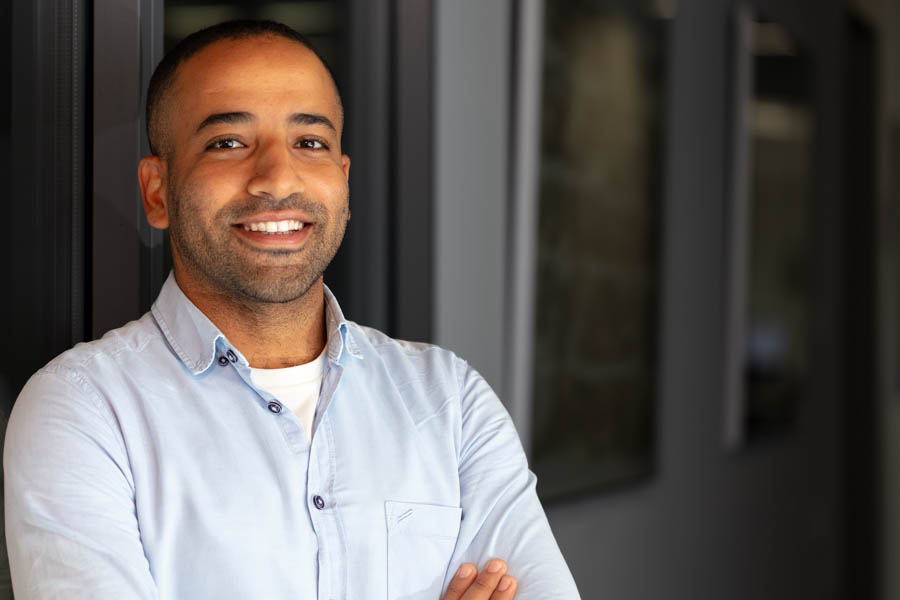
Ahmed Farag, M.Sc.
+49 241 80–25635
Funding
This work has been performed as part of CircSmeltSteel project which has received funding from the European Union’s Horizon Europe Research and Innovation Programme under Grant Agreement No. 101294187.
Funding is provided under the call “HORIZON-CL4-INDUSTRY-2025–01-TWIN-TRA.”