
AI4EAFRoute: Artificial Intelligence Supporting Innovative EAF Route Methods for Process and Plant Management to Enhance Performance and Component Effectiveness
Research Fund of Coal & Steel, 1 July 2026 — 30 June 2030
Project description
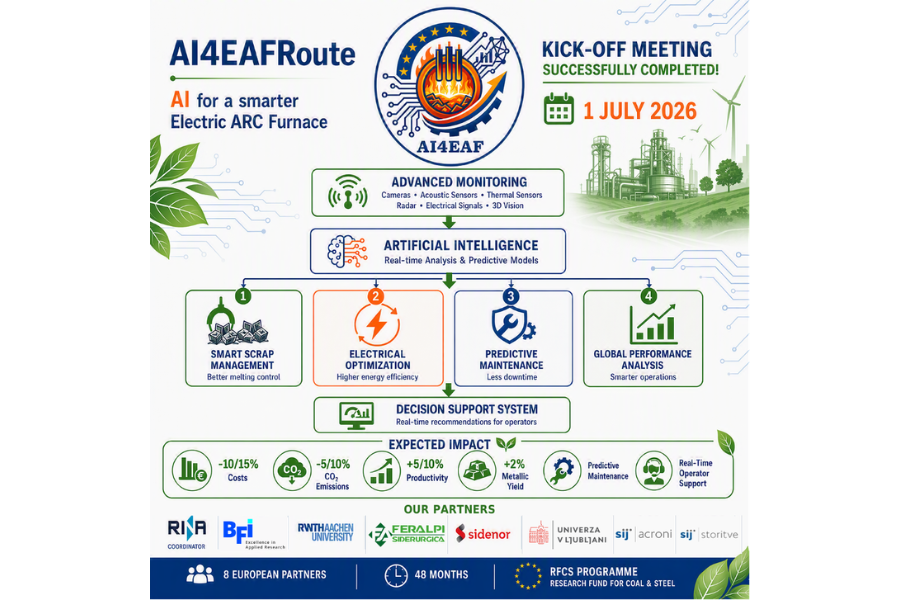
This project aims to enhance the performance, reliability, and sustainability of the Electric Arc Furnace (EAF) route by integrating advanced monitoring technologies with artificial intelligence (AI) tools. Through four targeted use cases, the project will tackle key process challenges, including scrap melting management, optimization of electrical parameters, refractory lining erosion, water leakage in panels, event recognition and prediction, and overall performance management. For each use case, dedicated AI models will be developed using real industrial data and leveraging multimodal inputs such as acoustic, volumetric, visual, and thermal signals. The approach followed will include the monitoring and data analysis of equipment status in parallel with the typical approach used for process monitoring and management, to study the influence of the adopted operating practices on equipment condition and durability, and to evaluate the impact of component ineffectiveness on process performance. Both evaluations will be translated into simplified prediction rules, to be used also as part of the guidelines for a Decision Support System. These models will be integrated into an advanced AI-based Decision Support System (DSS), designed to provide furnace operators with real-time recommendations. This will enable more precise process control, reduced unplanned maintenance, extended equipment lifetime, and significant cost and energy savings. The project advances the state of the art on several fronts. In Computer Vision, it will introduce novel techniques for robust image analysis under the harsh conditions of EAF environments. In time-series analysis, it will apply advanced AI methods to acoustic signal patterns, enabling the early detection of inefficiencies and failures. By combining these innovations, the project will deliver a holistic and predictive approach to EAF management that is not currently available on the market. Ultimately, the project will strengthen both the decarbonization and the competitiveness of the European steel industry by optimizing EAF processes and management. In doing so, it directly supports the objectives of the RFCS program and the European Green Deal, through improved resource efficiency, higher metallic yield, and reduced CO₂ emissions.
Project goals
The consortium has identified four key use cases to be investigated, each contributing to the overall goal of optimizing the management of the Electric Arc Furnace (EAF) melting process. For each use case, a dedicated Artificial Intelligence (AI) model will be developed to address specific process challenges and enable more effective decision-making:
- EAF scrap melting management: This use case focuses on identifying relationships between the type of scrap and the melting performance, using volumetric data analysis for scrap basket obtained through radar measurements or 3D laser scanner and acoustic sensor for melting process.
- EAF electrical management: This use case aims to develop an AI-based model that leverages the novel Arc Quality Index (AQI) for optimization of the EAF operation. By integrating high-speed measurements of electrical variables, physics-based soft-sensing, and AI models trained on expert knowledge, the system will estimate arcs stability and their coverage by slag, and recommend optimal transformer tap settings, electrode position, and C and O2 injection during varying melting stages.
- EAF components and events management: The following section broadly encompasses three major goals: local panel management, events detection for alert management, and overall lining and electrodes management.
- EAF global performance analysis: this use case aims to demonstrate how process data (electrical consumption, metallic yield, heat duration, steel and slag composition, and temperatures) together with the digitalization of equipment status, damages, and maintenance operations can be leveraged to train AI algorithms for production optimization.
The outputs from these four AI-driven use cases will be integrated and further analysed by a higher-level AI model. This final model will serve as the foundation for a Decision Support System (DSS), designed to assist furnace operators in real time, improving process control, efficiency, and equipment lifetime.
Project participants
- RINA Consulting- Centro Sviluppo Materiali SPA
- VDEH-BETRIEBSFORSCHUNGSINSTITUT GMBH
- Department for Industrial Furnaces and Heat Engineering, RWTH Aachen University
- FERALPI SIDERURGICA SPA
- SIDENOR INVESTIGACION Y DESARROLLOSA
- UNIVERZA V LJUBLJANI
- ACRONI PODJETJE ZA PROIZVODNJO JEKLA IN JEKLENIH IZDELKOV DOO
Contact

Amit Sharma, M.Sc.
+49 241 80–26071

Dr.-Ing. Thomas Echterhof
+49 241 80–25958
Funding

Funded by the European Union. Views and opinions expressed are however those of the author(s) only and do not necessarily reflect those of the European Union or European Research Executive Agency. Neither the European Union nor the granting authority can be held responsible for them.